One arrested in armed robbery on Walpole Island

Blake Ellis Photo
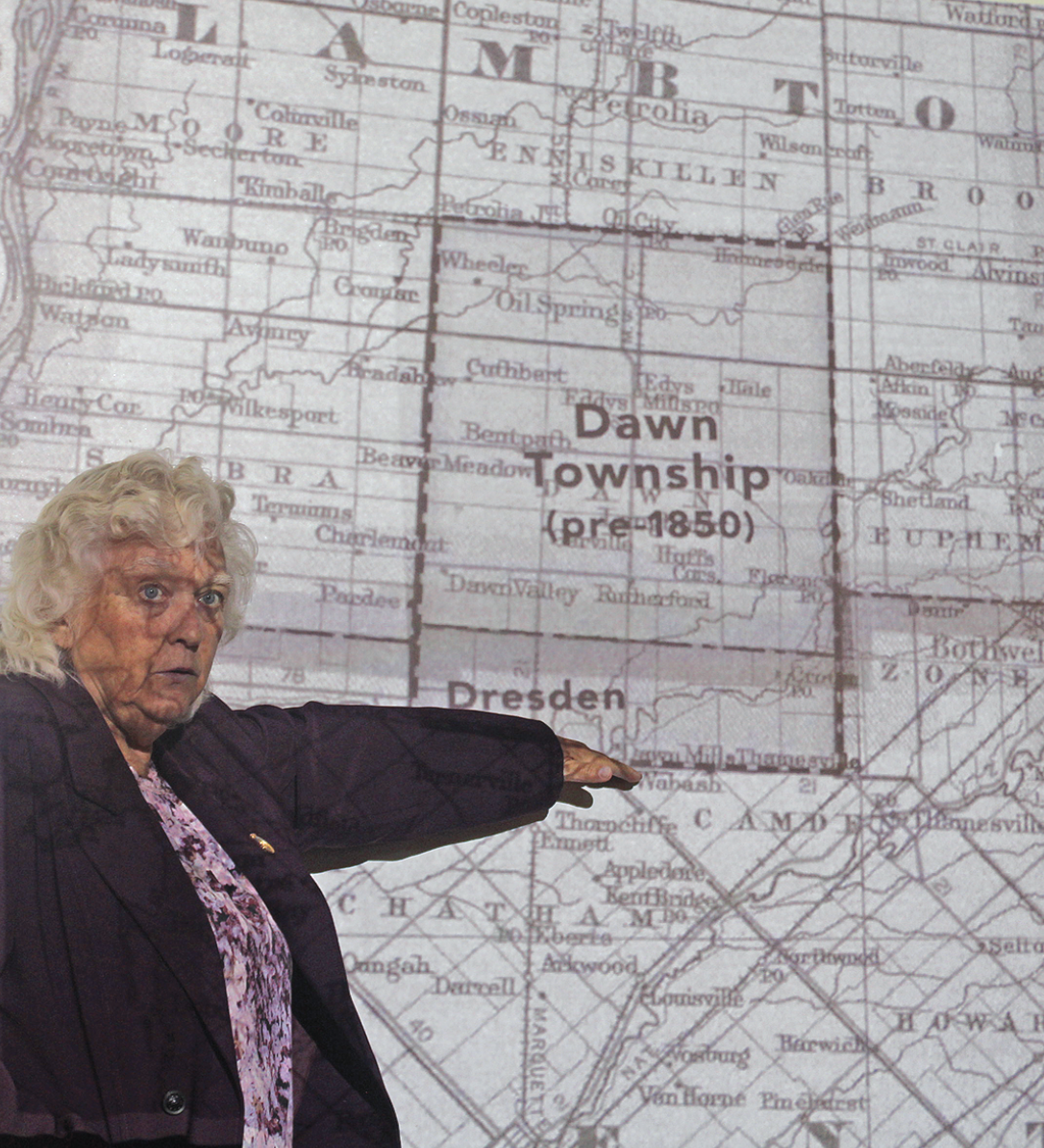
Marie Carter during her presentation at the Oil Museum of Canada Saturday Sept. 27.
‘This is very much a history of Lambton County as well’
October 6, 2025
Author of book on Black History says settlements existed in Lambton as well
Blake Ellis/The Independent
“I want to point out where this is very much a history of Lambton County as well, “ said Author Marie Carter, as he talked about her book, In the Light of Dawn.
Carter gave a talk Saturday at the Oil Museum of Canada about her book, which delves into the history of the Dawn Settlement, a black community near Dresden.
As Black settlers came into Ontario from the United States, it was a volatile period in our history and things changed a great deal, said Carter, particularly with the Underground Railroad, which shepherded escaped slaves to freedom.
There were as many as 30,000 black settlers who settled in this corner of southwestern Ontario between the 1820s and the start of the American Civil War in the 1860s. Many of these smaller communities have been lost.
“We don’t talk about them in a lot of the standard histories of our communities because for some reason, people don’t seem to put a lot of value on Black histories,” said Carter.
Sometimes these communities didn’t exist for very long. Some settlers were only in the area for less than a decade and therefore aren’t registered in the census.
One place historians have been able to uncover their existence has been in the land records.
There once was a thriving black community near Florence in Euphemia Township, which was documented in letters written by missionaries.
The book, The Life and Letters of Lewis Champion Chambers, written by Hilary Bates Neary, describes in detail the records Rev. Chambers sent to the American Anti-Slavery Society and it talks about the Euphemia community.
Rev. Chambers’ ministry was centred in Dresden but he travelled a great deal to help the new settlers, whether it was to teach them to read or write or to look after their spiritual needs.
Chambers ministered to some of the “poorest of the poor” and to those who lived in the most remote locations of the time. He organized camp meetings in the bush where both white and black settlers attended, as well as Indigenous people.
Black settlers also migrated to Oil Springs from the Dawn settlement near Dresden as well as the near Chatham for opportunities during the oil rush.
At one time, Black residents accounted for one third of the population of Chatham.
Tension rose in Oil Springs because the Black residents were under cutting the price of cord wood.
Because of this economic competition, a mob of white settlers formed on March 14, 1863 and burnt down the homes of the Black population, causing them to flee to safety in the woods.
This race riot was told through the book, Grease Town by Ann Towell.
As for Carter, she became interested in the history of Dawn settlement and Josiah Henson, having lived near the Josiah Henson’s House.
Henson escaped from slavery in Kentucky and brought as many as 118 people out of slavery and into Canada and was a force in the abolition movement.
He founded the Dawn Settlement and established the British-American Institute, which provided Black settlers with vocational education.
About 500 people lived in the Dawn Settlement at its peak.
Henson published his biography, The Life of Josiah Henson, Formerly a Slave, Now an Inhabitant of Canada, as Narrated by Himself which inspired Harriet Beecher Stowe to write Uncle Tom’s Cabin.
Henson’s home is part of the Josiah Henson Museum of African Canadian History in Dresden.
Carter began asking questions at six-years of age about the historical site and it would grow into a life long interest culminating with the recently published book on the settlement and its impact on the surrounding community.

Front Page
One arrested in armed robbery on Walpole Island
October 8, 2026
The Independent A Walpole Island man is facing charges after an armed robbery. Oct. 6, around 8:45 am, Walpole Island Police, Lambton OPP, the West Region Emergency Response Team and the Canine unit were called to an armed robbery at a business on Tecumseh Road. Police say a man went into the business, brandished a gun and took products before
Read More
Front Page
Plympton-Wyoming mayoral candidate suggests using mayor powers to pick top staff
October 7, 2026
Heather Wright/The Independent Plympton-Wyoming Mayoral Candidate Tim Wilkins says he’s not a “big believer” in Strong Mayor Powers but says if he did use them, it would be to pick the town’s chief administrative officer. The statement came during the first of two All-Candidates night in the town; this one organized by the Huron Shores Optimist Club in Camlachie Oct.
Read More
Front Page
Politicians did know about Clean Harbors project says CAO
October 7, 2026
Heather Wright/The Independent St. Clair Township officials say members of councillors were aware of a new storm water project at Clean Harbors. And, they say, officials have not yet considered appealing the decision by the Environmental Compliance Approvals Branch of the Ministry of the Environment, Conservation and Parks allowing the project to go ahead. In Oct. 2025, the US-based company
Read More

Front Page
Flyers goaltender Brown posts first PJHL win
October 7, 2026
Barry Wright/The Independent A trip to Aylmer Saturday will be a lifelong memory for Petrolia Flyers goaltender Ryder Brown. He kicked out 44 shots for his first career PJHL victory backstopping the Flyers to a 6-3 win against the Spitfires. Rhett Joy and Casey Guerette led the winners with a goal and an assist each. Nathan Beer, Nathan Reidhead, Noel
Read More