Henderson to be new leader of Lambton IPM

No federal probe of York1’s Dresden project
October 24, 2025
Heather Wright/The Independent
The head of the Impact Assessment Agency of Canada says there is no need for a federal probe into York1 Environmental’s recycling and landfill project in Dresden.
President Terence Hubbard, in a decision released late Friday, said there other provincial and federal laws which would address the concerns raised by the community.
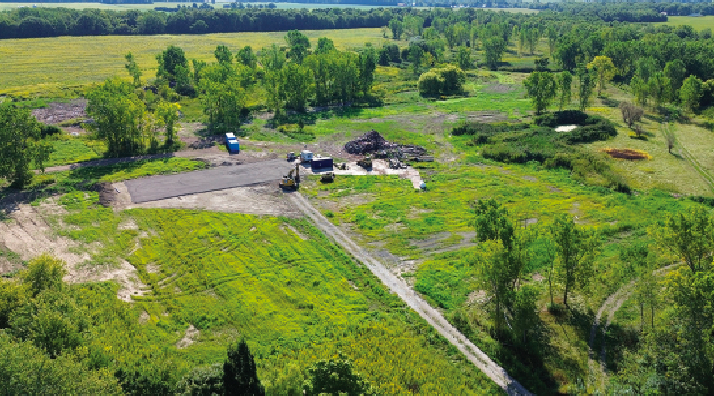
York1 plans a construction waste and “regenerative recycling” facility at the site less than a kilometre from Dresden. It was used in the 1960s to landfill the town’s fly ash from its incinerator and in the 80s as a wood waste recycling facility.
York1’s plan expands the dump, which covered about two acres of the 85-acre site, to a 20-acre landfill, bringing up to 6,000 tonnes of construction waste and soil a day to Dresden to be recycled or landfilled. .
Lambton and Chatham-Kent residents and politicians objected and asked the province to require the project to have a full Environmental Assessment. The Conservative government agreed in 2024. Then, in 2025, after winning its third majority government, the Ford government reversed the decision, allowing the company to use the Environmental Compliance Assessment system. It allows limited public input or consultation with Indigenous communities.
As the ink dried on the legislation reneging on the Ford government’s promise, the Canadian Environmental Law Association filed a request with the Impact Assessment Agency on behalf of Dresden CARED. It cited concerns about the environment, particularly rare species in the nearby Sydenham River, and that Indigenous communities would not have enough input into the process.
York1, in its submission, said work on the landfill was already underway. That’s one of the reasons the federal agency would reject a call to review the plan. Chatham-Kent disagreed in its submission to the IAAC.
But in the end, Hubbard did not make comment on whether the project was underway but instead said there are federal and provincial laws which can deal with the concerns raised. “There are means other than an impact assessment, such as the following federal and provincial mechanisms, that would permit a jurisdiction to address the adverse effects within federal jurisdiction and the direct or incidental adverse effects that may be caused by the carrying out of the project,” Hubbard wrote.
He said federal legislation, including the Fisheries Act, Migratory Birds Convention Act and Species at Risk Act and, provincial legislation, including the Environmental Protection Act, Ontario Water Resources Act, Clean Water Act, Conservation Authorities Act, Endangered Species Act or Species Conservation Act, when it comes into effect and Ontario Heritage Act.
That was the stand York1 took in its submission which said “there are no significant impacts to federal jurisdiction on the environment or Indigenous rights that cannot be adequately considered and comprehensively addressed under the required provincial permit process under the amendments sought to the ECAs.”
The municipality and CELA contend the provincial protections have “been stripped away” by the province’s Unleashing the Economy Act which “opened significant gaps” addressing environmental impacts and the affects on Indigenous communities.
In a video on social media, Stefan Premdas, said the group and its lawyers were “surprised” by the IAAC’s decision, which came a month before the deadline for the decision.
Premdas says CELA lawyers as well as municipal officials and leaders of the Walpole Island First Nation are reviewing the decision and will meet next week to see if an appeal “would be right for us in this situation.”

Front Page
Henderson to be new leader of Lambton IPM
September 30, 2026
The Independent The Lambton County International Plowing Match has a new leader. Dave Henderson will lead the group bringing the massive farm show to Lambton County in 2027. The 2027 IPM was originally planned at the Brigden Fairgrounds. Planning was well underway when the local committee quit saying it would not host the event because a deal was not in
Read More
Front Page
Petrolia can’t afford bigger arena alone: candidates
September 30, 2026
Heather Wright/The Independent If there is a new arena to be build in Petrolia, it only happen with help from the town’s neighbours. That’s the opinion of the people who are vying for councillor positions around the town council table Oct. 26 about arequest for a double ice pad which came to council more than two years ago. Lisa Vanderwal
Read More

Front Page
Flyers get home opener cut short because of poor ice
September 30, 2026
Barry Wright/The Independent It’ll be take two for the Petrolia Flyers on home ice Thursday when the North Middlesex Stars visit Greenwood for aPJHL contest beginning at 7:30 pm. Petrolia’s home opener Sept. 24 was cancelled at the end of the second period due to what the team called unsafe ice conditions. The Flyers were leading Exeter, 3-1 at the
Read More

Front Page
Sports Briefs: Tecumseh tops Wyoming in OBA championship game
September 30, 2026
Barry Wright/The Independent The Wyoming Cattlebarons will go down as the second-best Senior AA baseball in Ontario for 2026. After a month-long delay due to inclement weather, the Tecumseh Thunder beat the Barons, 10-1 in the OBAchampionship game on Sunday in Kincardine. The Thunder had reached the final with a 2-0 win over New Lowell (Barrie area) in the semifinal
Read More